| Basic Specifications |
|---|
| Resolution: | 10.20 Megapixels |
|---|
| Kit Lens: | 3.00x zoom
18-55mm
(27-83mm eq.) |
|---|
| Viewfinder: | Optical / LCD |
|---|
| LCD Size: | 2.7 inch |
|---|
| ISO: | 100-3200 |
|---|
| Shutter: | 30-1/4000 |
|---|
| Max Aperture: | 3.5 |
|---|
| Mem Type: | MS Duo / MS PRO Duo / SDHC |
|---|
| Battery: | Custom LiIon |
|---|
| Dimensions: | 5.0x3.8x2.8in
(128x97x71mm) |
|---|
| Weight: | 17.3 oz
(491 g) |
|---|
| MSRP: | $649 |
|---|
| Availability: | 06/2009 |
|---|
 | 10.20
Megapixels |
|---|
| Sony Alpha (Minolta A) mount |
|---|
2.7 inch
LCD |
|---|
Sony A330 Overview
Previewed by Shawn Barnett
Date Posted: 05/18/09
Bucking the trend toward greater complexity and higher resolution, Sony has revamped their consumer digital SLR line with a new focus on even greater simplicity, lower-cost cameras, and more affordable beginner optics. Indeed, the three new SLRs, the Sony A230, A330, and A380 share more specifications in common with their predecessors than they do differences, with the main changes occurring in the size, weight, and shape categories.
Resolution for all three bodies is unchanged. The Sony A230 and A330 both have a 10.2-megapixel sensor, and the A380 has a 14.2-megapixel sensor. And though the A330 and A380 both have the fastest Live View mode available, thanks to the secondary image sensor built into the pentamirror housing, they have no built-in movie mode in any model. In fact, it's that very design that makes adding a movie mode to these models more difficult.
The Sony A330's new body design features fewer buttons to avoid confusing the user, and a few tweaks to the Function menu and the Status display. All three cameras are also bundled with a new 18-55mm lens to replace the 18-70mm lens previously used as a kit lens. The new design is shorter and lighter, and is the first of the company's new SAM lens line. Standing for Smooth Autofocus Motor, the new electronically linked lenses are designed to be less expensive than Sony's current offerings, while still offering high optical quality. One new long zoom lens will be available that is based on the current 55-200mm f/4-5.6, upgraded with the new SAM. Two prime lenses will follow the three cameras: the 50mm f/1.8 SAM "Portrait" lens priced at $149 and available in mid-July, and the 30mm f/2.8 SAM Macro lens. Pricing and availability of the 30mm f/2.8 Macro lens is unknown at this time.
The Sony A330 includes support for both Memory Stick Duo and Secure Digital cards, and a manual switch selects between the two. Gone is support for CompactFlash, as is now true for most consumer SLRs.
A new Help system joins the improved DRO brought over from the A900 and the Sony A330 and its new brothers have the SteadyShot Inside feature. There are a number of other feature improvements in the Sony A330, including bigger AF points, a new self-timer mode, and even a new optional flash, all of which we'll get to in the Hands-on Preview below.
All three cameras are expected to ship in June, with the Sony A330 priced at $649 with the 18-55mm kit lens, and $849 with the 18-55mm and 55-200mm lenses, covering an 11x zoom range. The Sony A330 is the only camera that will also be available in a Copper Brown color, including a matching kit lens. Be sure to check prices by clicking on the links above right and in the shopping pods below for the latest prices on the Sony A330!
Sony A330 Hands-on Preview
by Shawn BarnettIt's been just over a year since Sony shipped their last trio of consumer Alpha digital SLR cameras, the A200, A300, and A350, and already they've revamped the line with a new external design and a greater emphasis on economical features and accessories, starting with the Sony A230, A330, and A380. We got hands-on time with each of these models and prepared this report. Company representatives told us that extensive focus-group research revealed that people wanted simpler SLRs that didn't cost too much, and were lighter and easier to bring along. And among those who bought an SLR, many expressed a desire to buy at least one additional lens for their fancy interchangeable-lens digital camera, but few ever made the purchase, largely due to cost.
These studies clearly had an effect on the company's plans for their consumer digital SLR line, because the new cameras reflect significant change in the areas of weight, size, and simplicity, while the internal specifications remain mostly the same. Company representatives hastened to note that nearly each item in the cameras was redesigned to improve efficiency and reduce weight, and though the sensors are indeed the same, the new Alphas include a new image processing system.
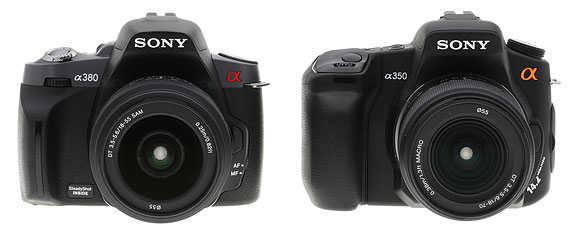
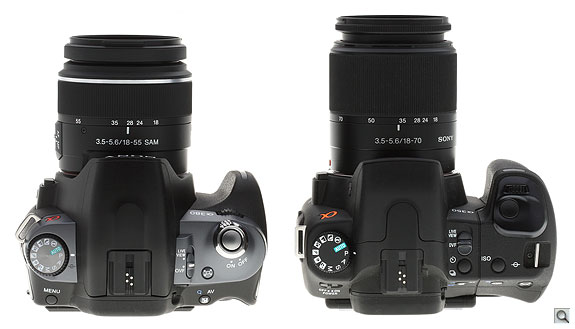
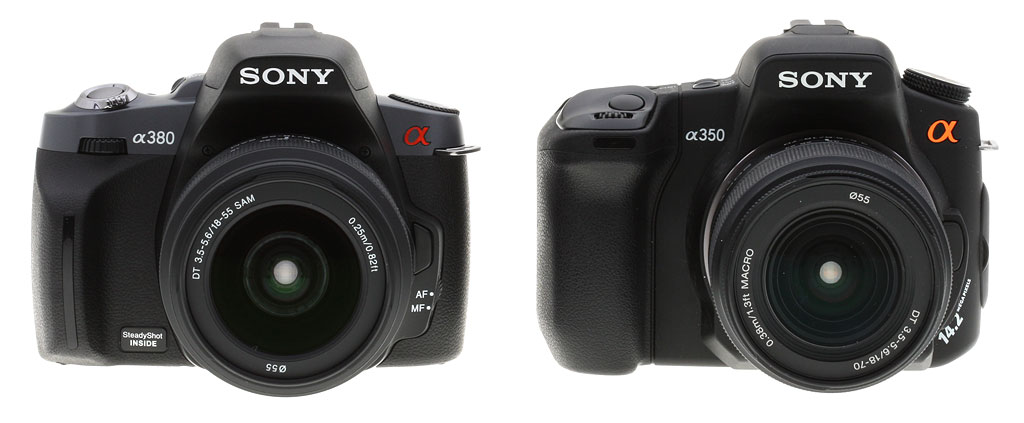
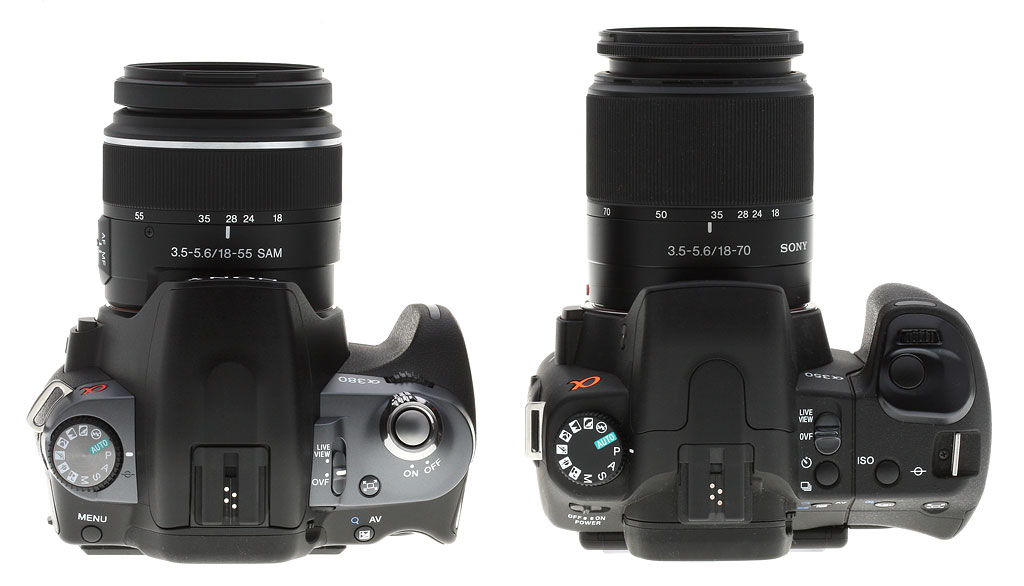
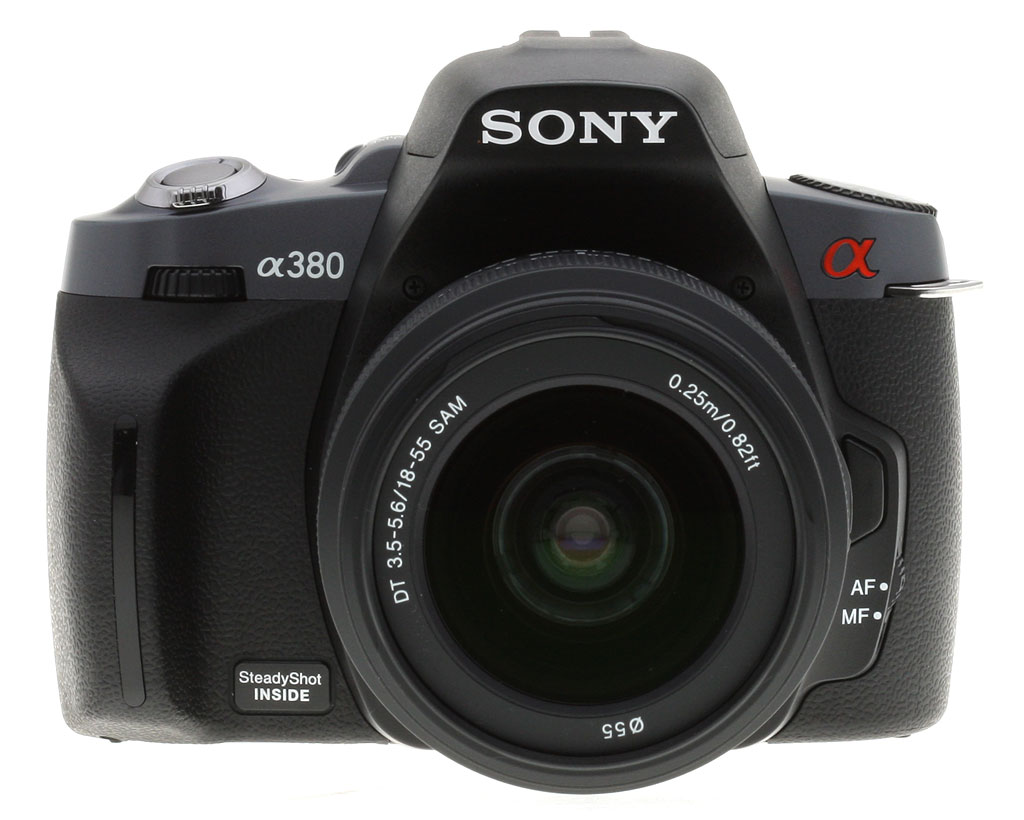
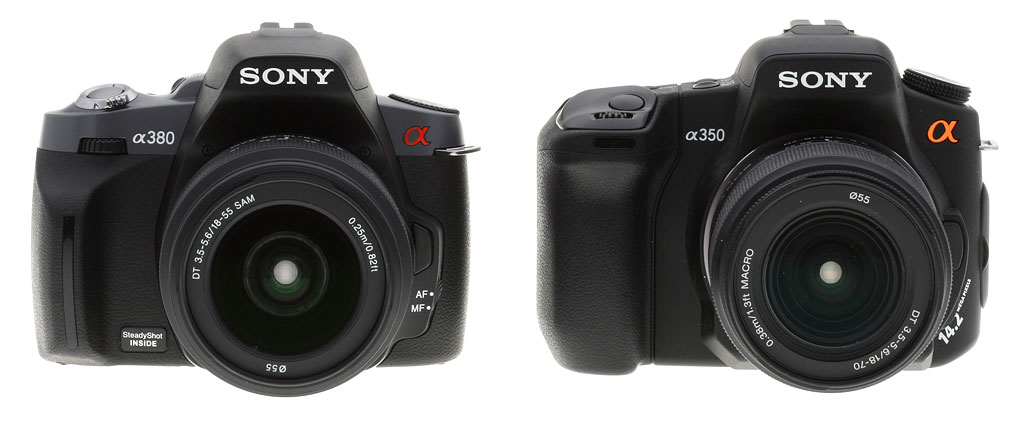
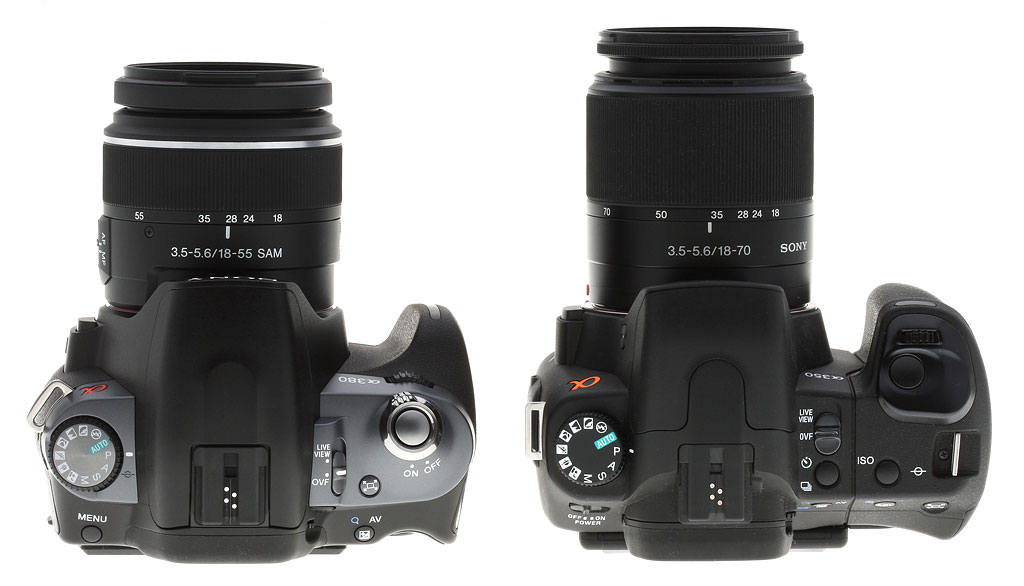
Revamped: Side-by-side, it's easy to see how the new small Alpha body and lens are different from the old, largely Konica-Minolta-based Alphas (the A380 is pictured, but all dimensions are the same as the A330). The grip is smaller, the lens shorter in both size and focal length, and the shutter button is further back on the camera's top deck.
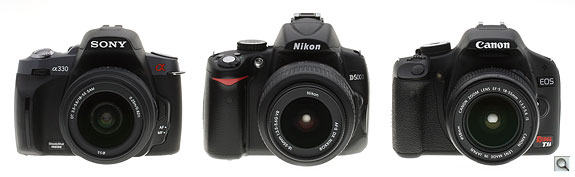
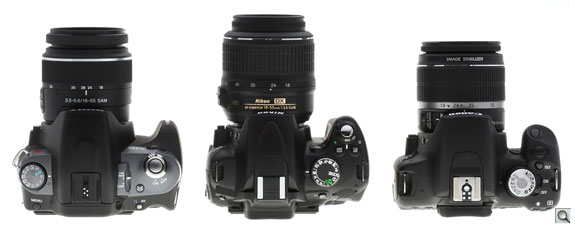
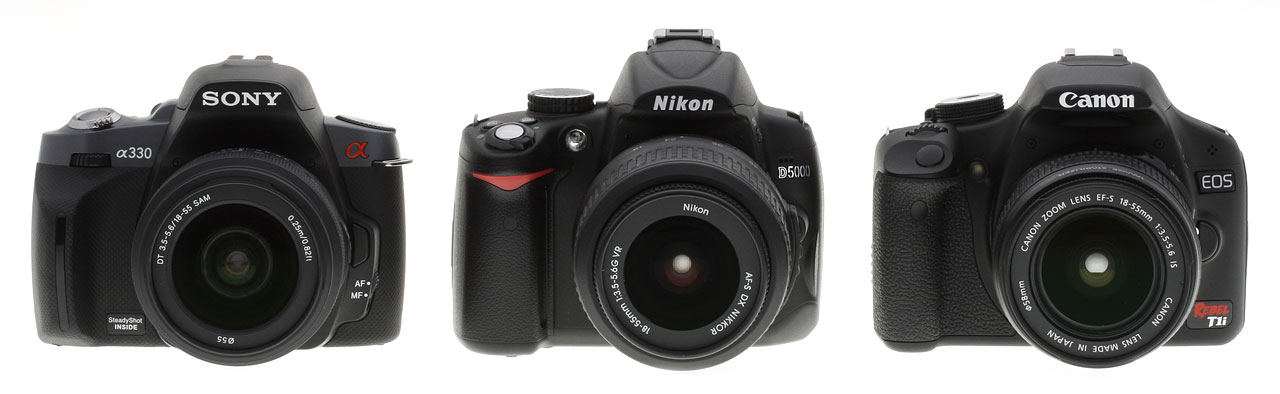
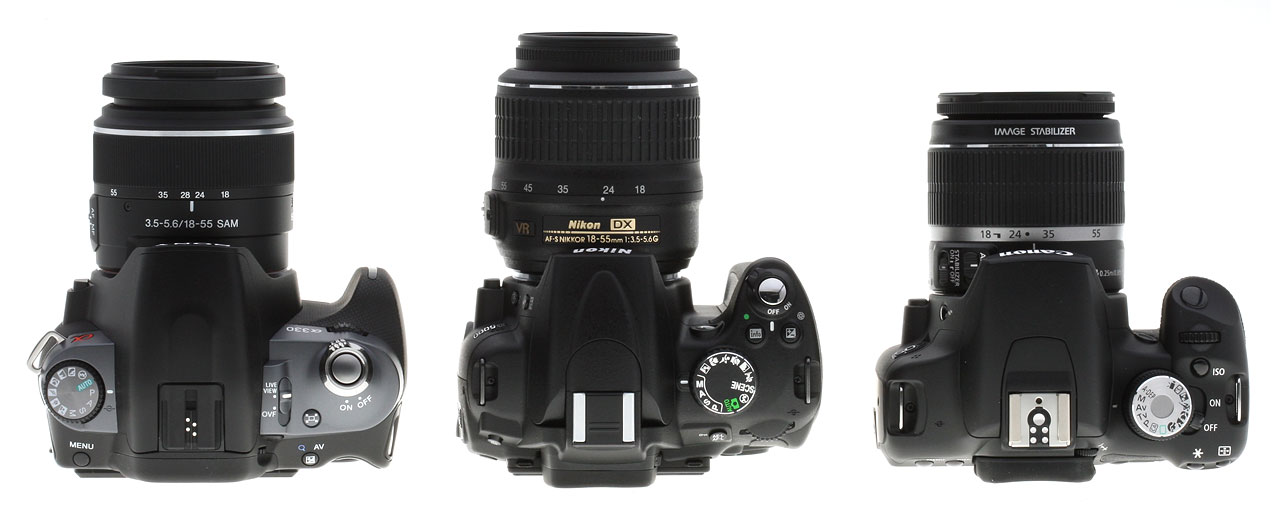
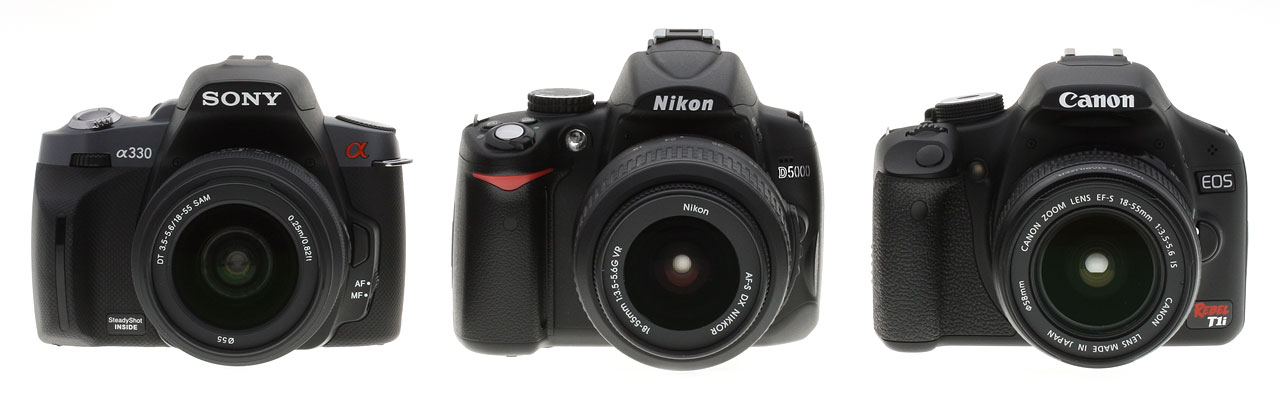
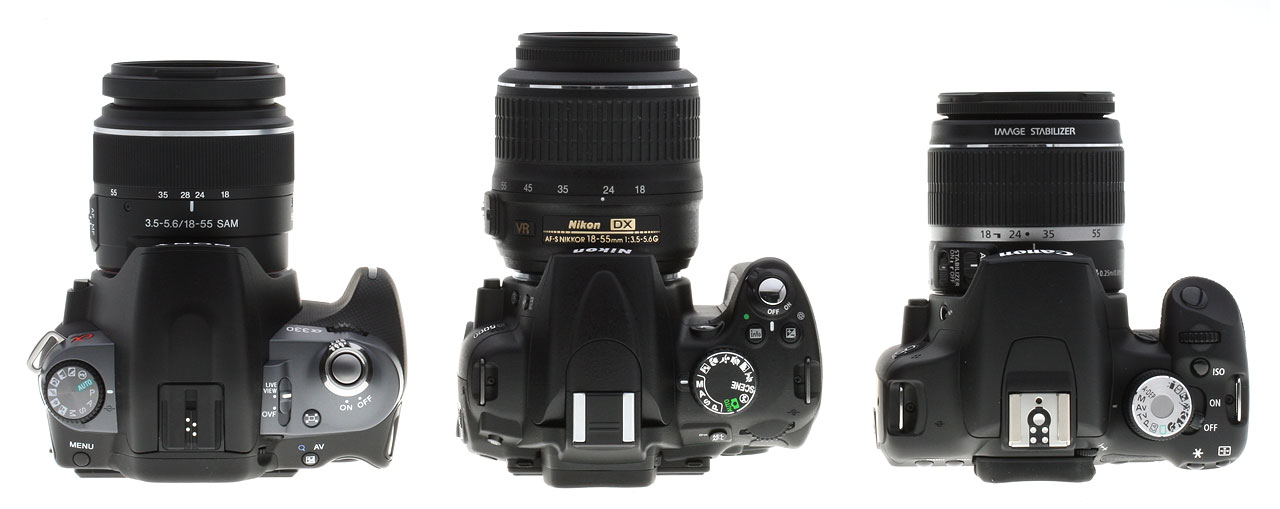
Competitive: Sony has achieved their goal of making the new Alphas smaller and lighter than their predecessors, though they are not significantly smaller or lighter than the competition. Fortunately for Sony, Canon and Nikon's latest consumer SLRs have gotten taller, so the Sony Alphas look shorter overall, and the new lens brings the camera's length front-to-back closer to the Canon XSi.
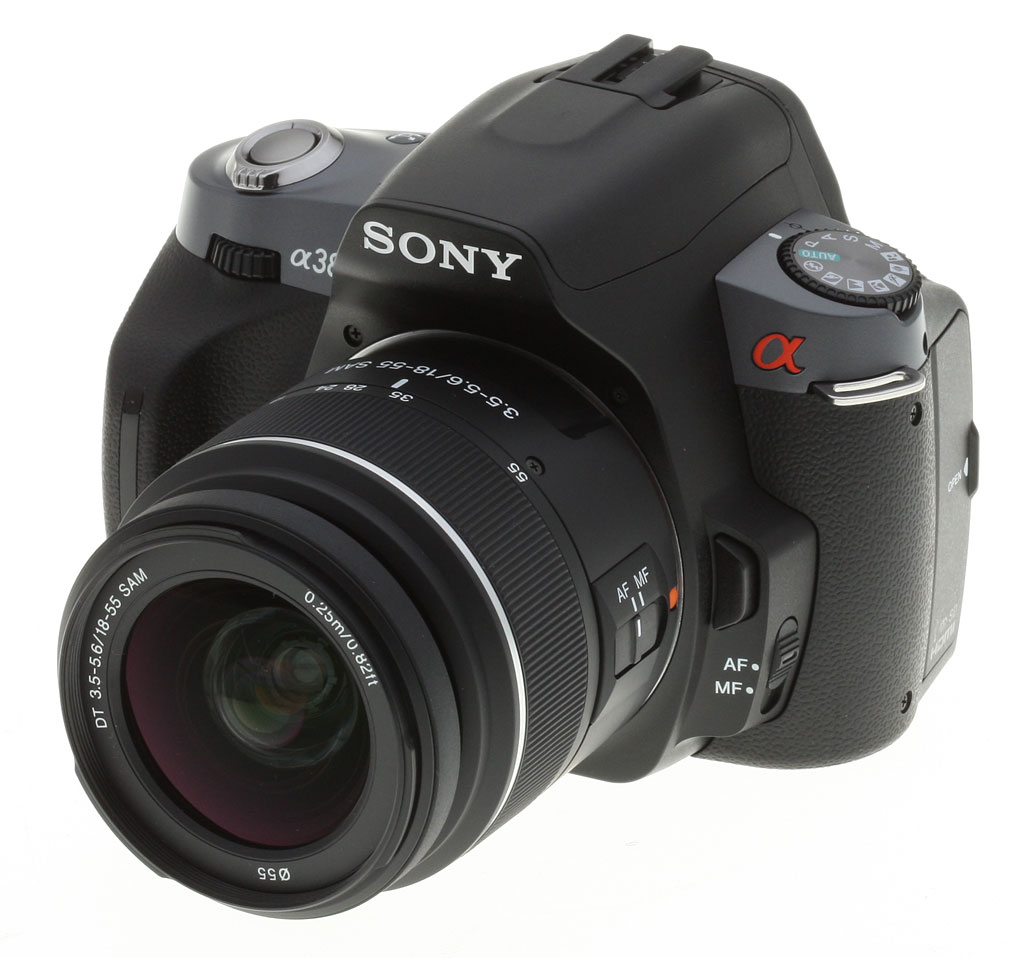
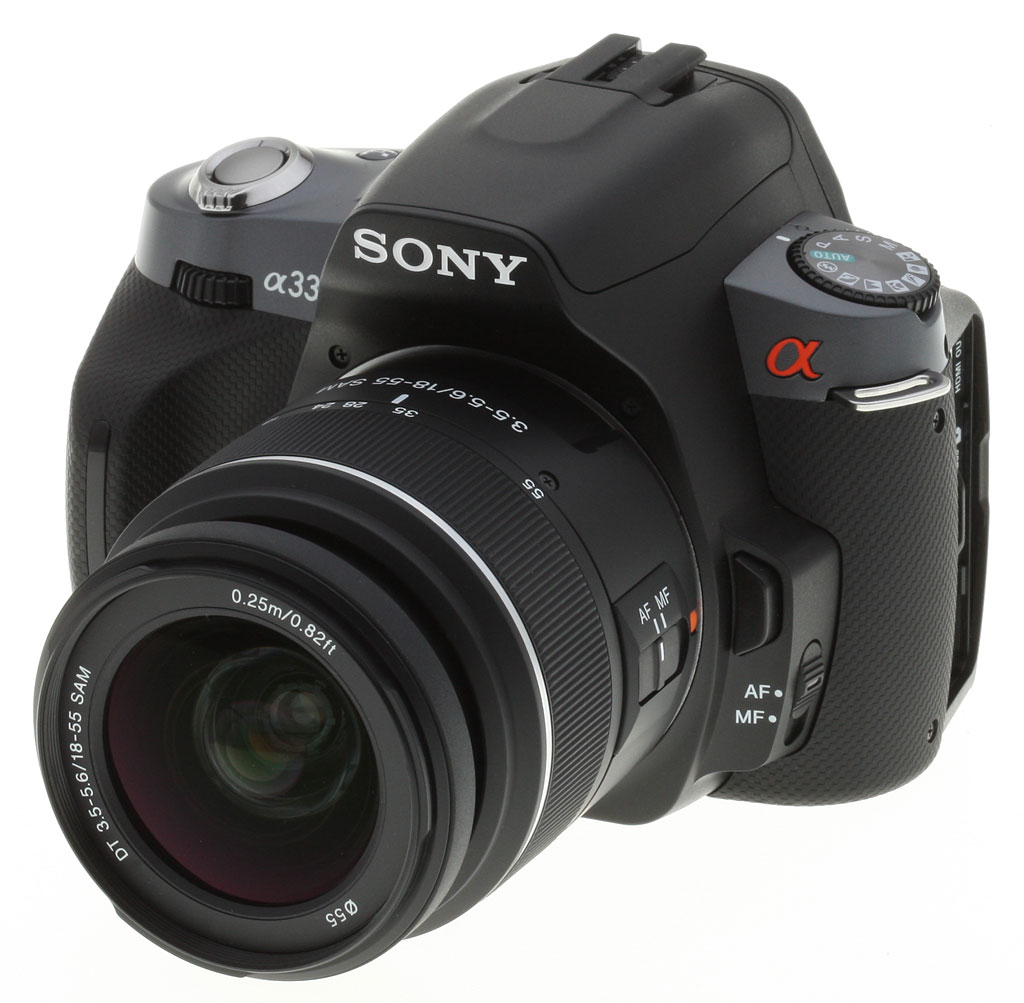
Look and feel. Sure to be the more popular of Sony's consumer line, the Alpha A330 is the same weight and size as the A380, and weighs about 40 grams more than the A230. The weight is well-balanced, partly thanks to the new lens.
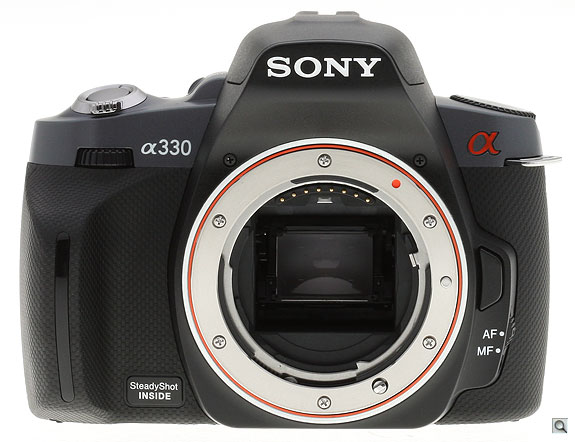
Much of the weight reduction is due to the significantly trimmed grip on the Sony A330, as well as its smaller Lithium-ion battery. Unlike most SLR grips, the Sony A330's stops well short of the camera's shutter release, and the shutter button now appears on the camera's top deck. Everyone on the staff disliked this new design; everyone, that is, but me, and I only accept it because you can easily adjust your grip by balancing the camera's base into the palm of your hand, which puts your index finger in better position to reach the grip, while your pinkie and ring fingers curl around the grip. After a bit of use, though, I could imagine this putting a strain on these latter two fingers, especially with a heavier lens mounted on the Sony A330. It seems Sony was aiming for a more retro look with this design, harking back to gripless film SLRs of days gone by, with their metallic tops and leather-covered bodies. The look is appealing once you get used to it, and those who use a camera strap and the new light SAM lenses will hardly notice the smaller grip.
The grip surface of the Sony A330 is distinctive, with its carbon-fiber woven look, while the other two new Alphas have a leather-like texture; all three have about the same feel.
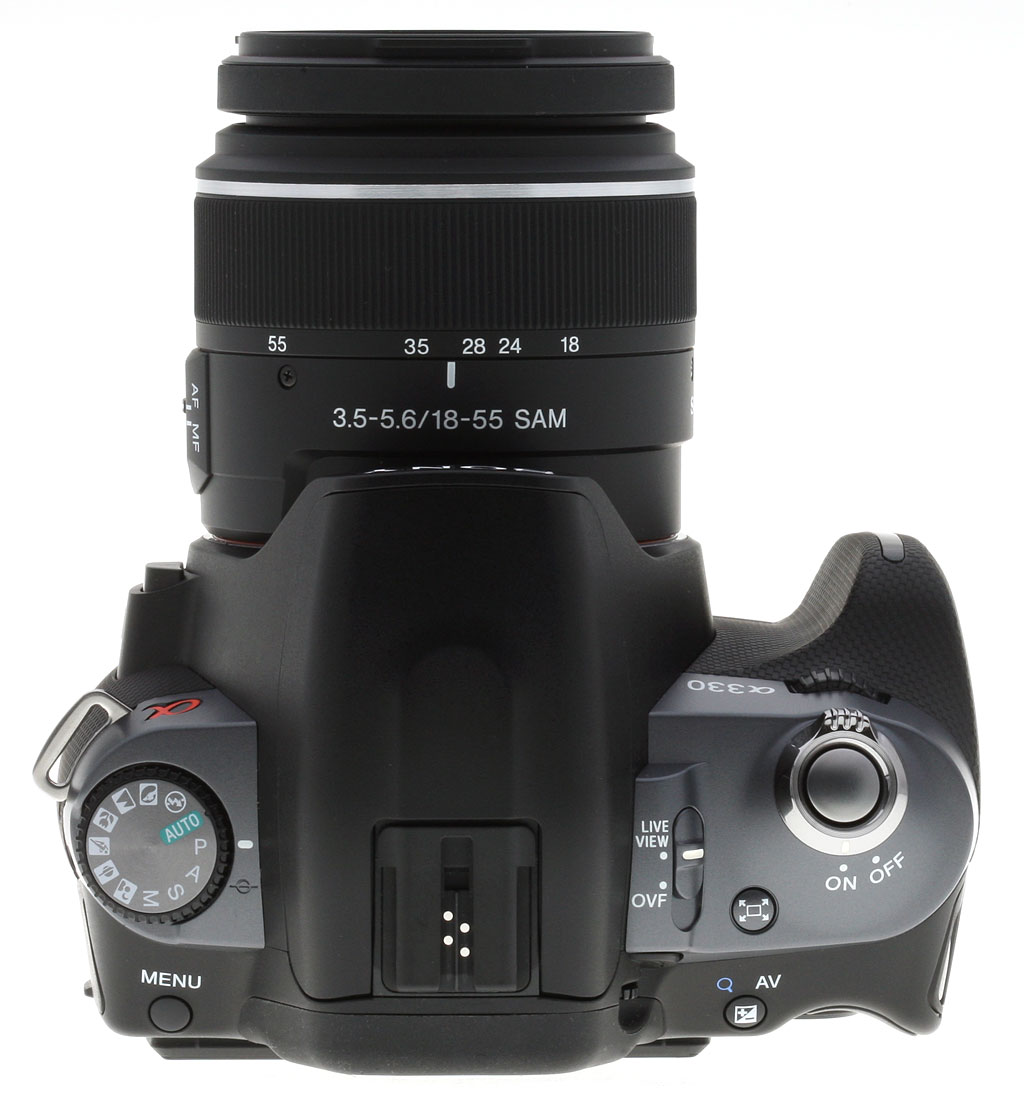
The Control dial now faces forward, just beneath the Sony A330's Shutter release button. The lens release button and AF/MF switch are in the same positions relative to past models. The Sony A330's Alpha logo is now smaller, embossed into the gunmetal-colored top of the two-toned body design. Above that, the mode dial is partially concealed, recessed into the top deck to reduce the chance of accidental activation.
There is still no depth-of-field preview button on the Sony A330.
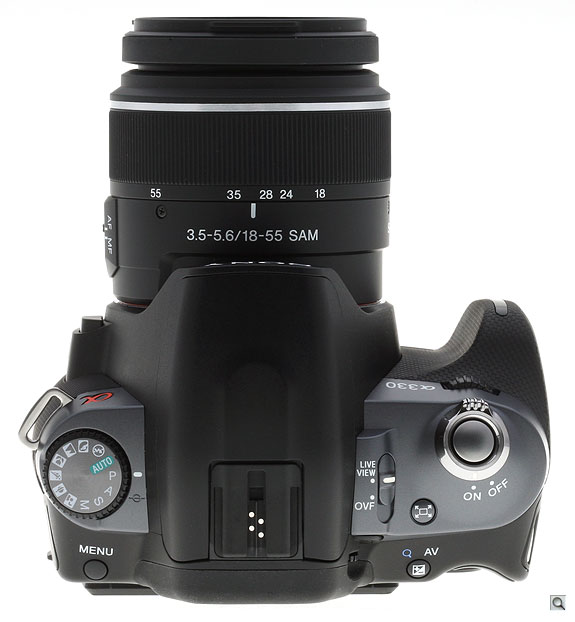
The Sony A330's new shorter lens includes a bayonet mount for a lens hood, but it was unclear from the samples we saw whether Sony would include a hood as they have in the past. The mode dial is only accessible from the rear and left side of the Sony A330. Sony moved the Power switch from the rear left of the camera's back to a better position surrounding the Shutter release button, a method also used by Nikon and Pentax on their SLRs. Gone is the flash activation button to the left of the lens mount, where it appears on most other digital SLRs. Sony said too many customers never thought to look there, so they've moved it to the Sony A330's rear navigation disk.
Also note the Live View/Optical Viewfinder (OVF) switch, which manually moves the front mirror of the pentamirror arrangement inside the Sony A330 optical viewfinder assembly, directing the light to the Live View sensor inside. A shutter also covers the optical viewfinder at this point, preventing light from entering and affecting the light meter.
Just right of that switch is the Smart Teleconverter button, which activates the Sony A330's digital zoom, only available in Live View mode, which zooms the view by 1.4x and 2x with successive presses of this button. The resulting image is cropped from the full image when it is saved to the card, but not upsampled, resulting in a smaller, pre-cropped image.
Note also the substantial thumb grip, which really does help when holding the Sony A330 as I've described.
What also helps your grip is the soft taper Sony applied to the bottom right of the Sony A330, which makes resting the camera in your palm more comfortable.
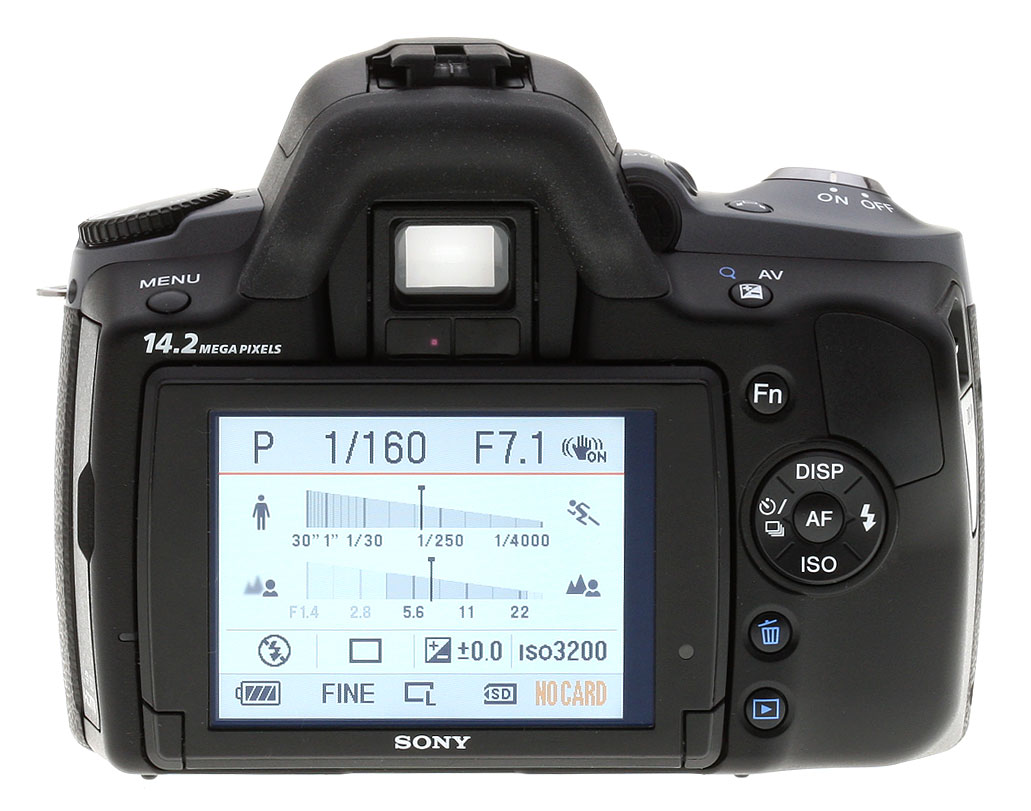
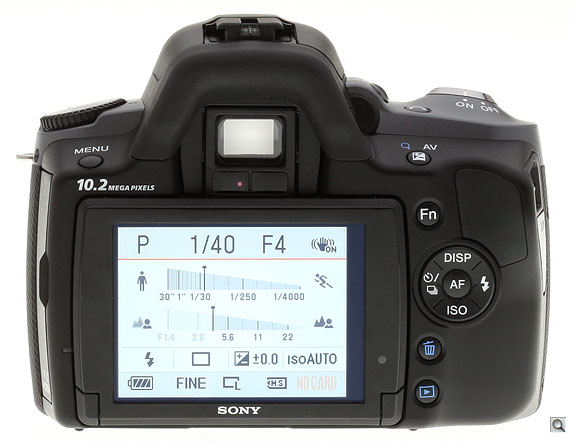
The back of the Sony A330 shows just how far Sony has gone toward simplifying the interface of these new cameras. The Display, Drive mode, ISO, and Flash buttons are now integrated into the four-way navigator, and the AE-Lock button no longer exists.
The rubber eyecup looks more integrated into the body, but it's still removable like any other eyecup, with an upward tug. The infrared sensor is also still in play, offering both the option to turn off the display when you bring the Sony A330 to your eye, as well as to start up autofocus before you even press the shutter button.
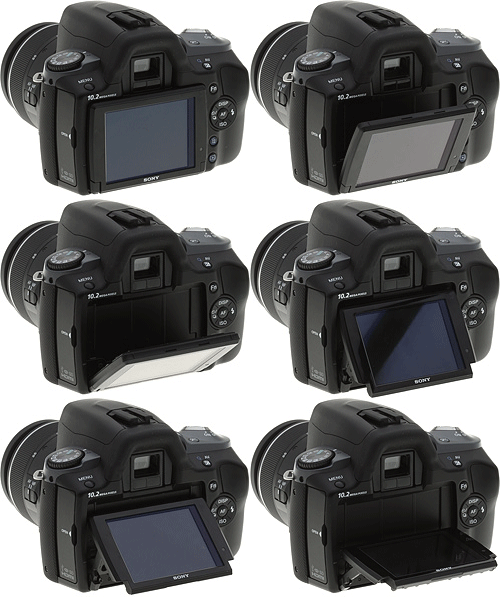
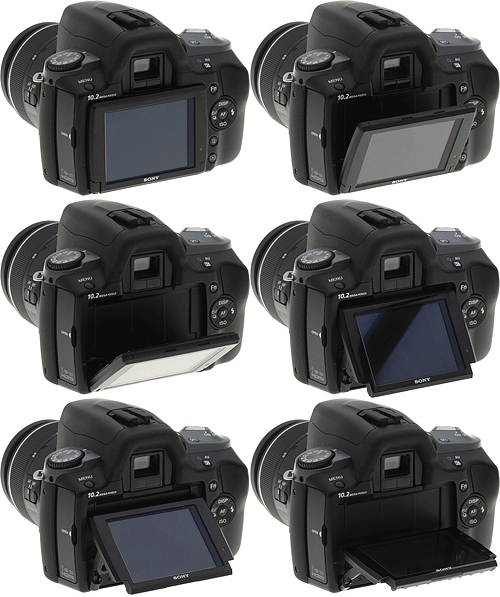
Recessed more deeply into the back of the Sony A330, the articulating LCD tilts a little further up and down. The card write lamp now juts out left of the LCD. Though it's an odd position, it beats being under the thumb, as it was on the A350. Note also the ambient light sensor on the lower right of the tilting LCD, which reads the light directionally and turns up the LCD's brightness in bright sunlight.
On the Sony A330's LCD itself is the new display screen, designed to help new users understand the relationship between shutter speeds and aperture.
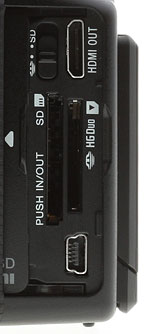
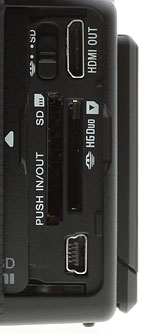
Ports. All but the power port on the Sony A330 come out of the camera's left side, including the HDMI Out and USB ports, as well as the SD and Memory Stick HG Duo card slots. Note also the Memory Stick/SD switch, a manual-only switching method. The whole array is concealed by a sliding pocket door that ducks down and slips inside the Sony A330's body.
Having the memory card slots on the left makes inserting and removing cards a little easier, because you don't have to let go of the Sony A330's grip to make the change, as you do on nearly every other digital SLR on the market. The choice of a pocket door also makes using the video and USB port much easier, thanks to the lack of a rubber door.
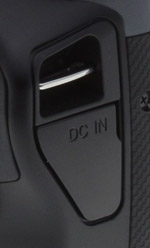
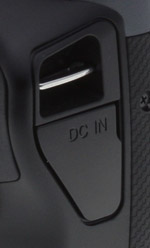
On the Sony A330's right is another port door, covering the DC-IN port. It's much more difficult to open than the pocket door, being of the rubber variety. Note also the camera strap lug, recessed so that it doesn't stick into the palm of your hand.
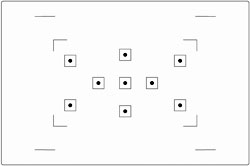
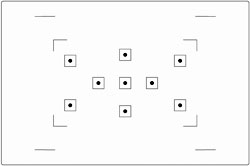
Viewfinder. Optical viewfinders are usually preferable on most digital SLRs, but the Sony Alpha series has had its shortcomings, most notably it's difficult-to-see AF points. I've always liked how they were angled to match the orientation of each autofocus sensor, but that also made them harder to see in some situations.
Sony has replaced them in the new SLRs, though, with larger round dots. The array is the same, but the visual effect is quite different, and it's now easier to see each point illuminate to indicate the in-focus areas.
Because of the secondary live-view sensor, the Sony A380 and A330's viewfinder magnification is smaller than the A230's: 0.74x vs 0.83x, respectively.
Live View. But you can also turn to the Sony A330's Live View mode by sliding the switch on the top deck, which, thanks to the interplay of mirrors and lenses, grabs the exact view from the viewfinder and displays it on the LCD. As I mentioned above, the view can be zoomed with the Smart Teleconverter button on the top deck; though it's important to remember that this mode will crop your image, not just zoom in to aid in focus, as we often see on other live-view SLRs.
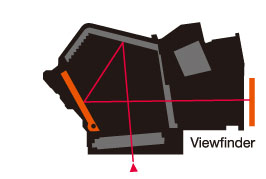 | 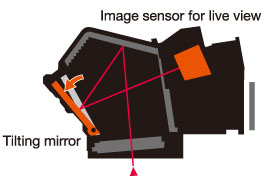 |
Optical Viewfinder. A normal pentamirror arrangement reflects the light out the optical viewfinder eyepiece. | Sony Live View mode. With a simple shift of one of the mirrors, Sony deflects the image up to another optic that reflects the image onto a secondary sensor. Because no partially silvered mirrors are used, the image is fairly bright, though not as sharp as competing designs. |
Because the Sony A330's Live View is through-the-viewfinder and through-the-lens, there is no delay for the mirror to flip down to autofocus, nor is there a longer delay while the camera employs contrast-detect autofocus on the scene. Autofocus and metering are just as fast as they are while you're looking through the optical viewfinder.
Live View is a little softer than it could be, as it was in the A300 and A350, especially in low light. Also, there is some manufacturing variability inherent in the Sony A330's Live View system, and if the mirrors, lens, or sensor are out of perfect alignment, what you see in Live View can differ from the optical viewfinder and the captured image; as it is, the view is clipped even from what you see through the optical viewfinder. Still, it's hard to discount the advantage you get with the Sony A330's version of Live View in terms of performance.
One disadvantage to Sony's current Live View design is that they weren't able to add a movie capture mode to the new cameras. Current manufacturers making digital SLRs that record movies, Canon, Nikon, and Panasonic, all draw their Live View record mode displays from the actual imaging sensor, so it's less mechanical and programming work for them to repurpose their live-view feed for video recording. Sony's viewfinder sensor is of fairly low resolution, and would also record the AF points, since the sensor is behind the focusing screen.
Sony A330 Interface
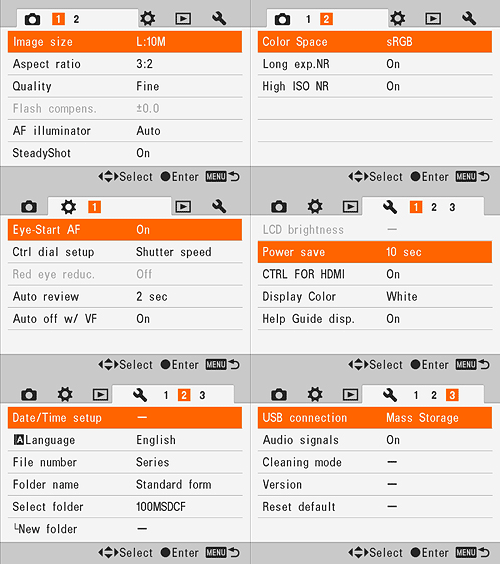
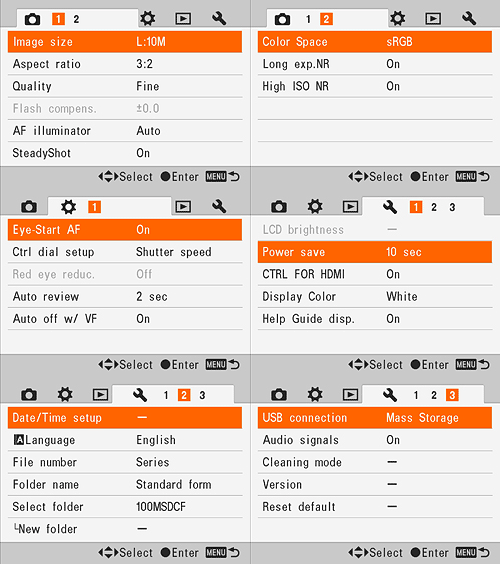
Menu. The Sony A330's menu is very easy to use, functioning like a tabbed menu and a scrolling menu. When you get to the bottom of the first tab's list, it automatically switches to the top of the next tab. This design makes it easy to scan through the items looking for what you need. If you see that a given tab isn't what you need, regardless of where you are in the list, you can press the left or right arrow to move between tabs. It's a little confusing if you've been using a Nikon, where pressing the right arrow often selects a menu item, but it's not hard to get used to using the center button instead.
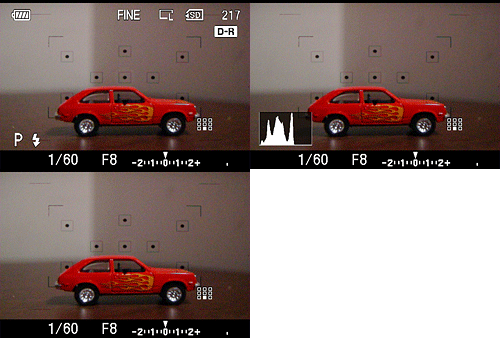
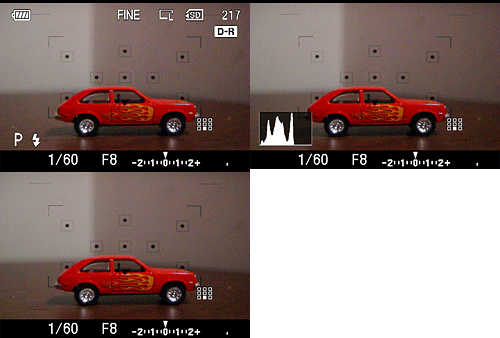
Live View LCD. In Live View mode, the Sony A330's viewfinder shows most of the information that the optical viewfinder shows, but since there's more room, the information is spread out over more of the screen area, rather than only across the bottom. The most critical component, besides the shutter speed and aperture, is the Super SteadyShot meter, which appears in the lower right corner of the screen, just as it does in the viewfinder.
Pressing the Display button brings up the Sony A330's histogram view, which includes a small, semi-translucent histogram in the lower left corner along with basic information across the bottom. There's also a mode with almost nothing overlaying the image area.
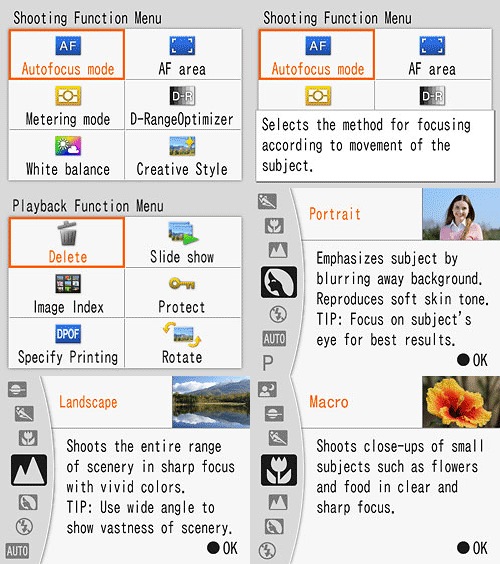
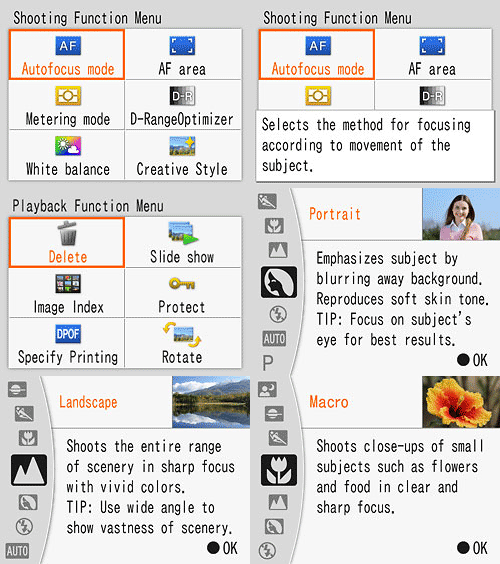
Function Menu and Help Guide display. Pressing the Sony A330's Fn (Function) button brings up a simple menu for adjusting most of the important items in both Record mode and Playback. Just use the Arrow pad to navigate to the desired option and press the center button to select your mode. If you stay on a given item for a moment, a plain-text explanation of each item pops up.
Likewise, as you turn the Mode dial, an onscreen display wheel appears on the left, with text and a sample image to explain each mode. The Help Guide display can be disabled in Setup menu 1.
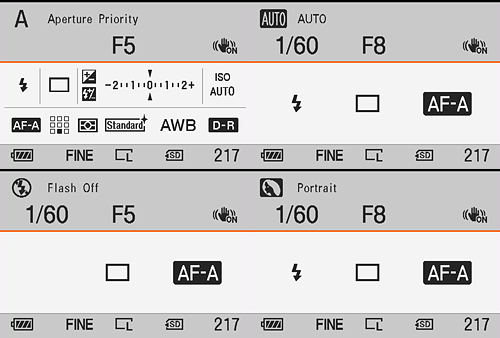
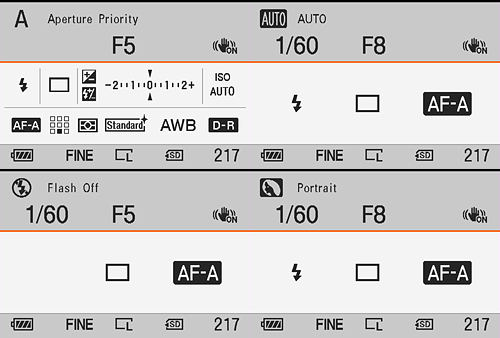
Status display modes. Sony has also added several display modes to the Status display. In addition to the standard display, which includes a large selection of camera settings, the Sony A330 has a simplified version, available when in full Auto modes, giving you only the small amount of information you need. (Screenshots at right were taken from the HDMI output, so they appear different from some of the others here.)
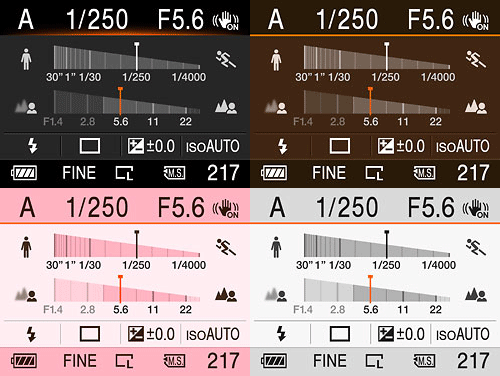
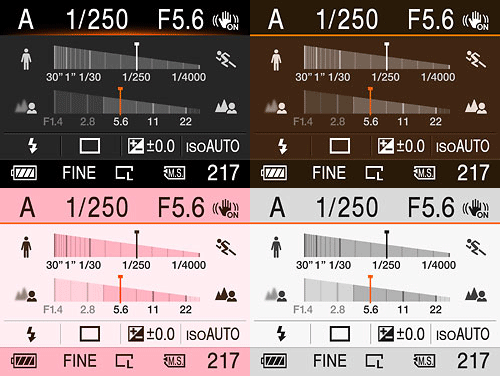
A new graphical display on the Sony A330 attempts to illustrate how moving in either direction on the shutter speed or aperture scale will affect your images, with a scale that changes in size from large to small as you move from long and large settings to shorter and smaller settings, respectively. You can also change screen colors. Finally, when you turn the Sony A330, the display rotates with it, re-orienting the entire arrangement (not shown).
Sony A330 Lens options
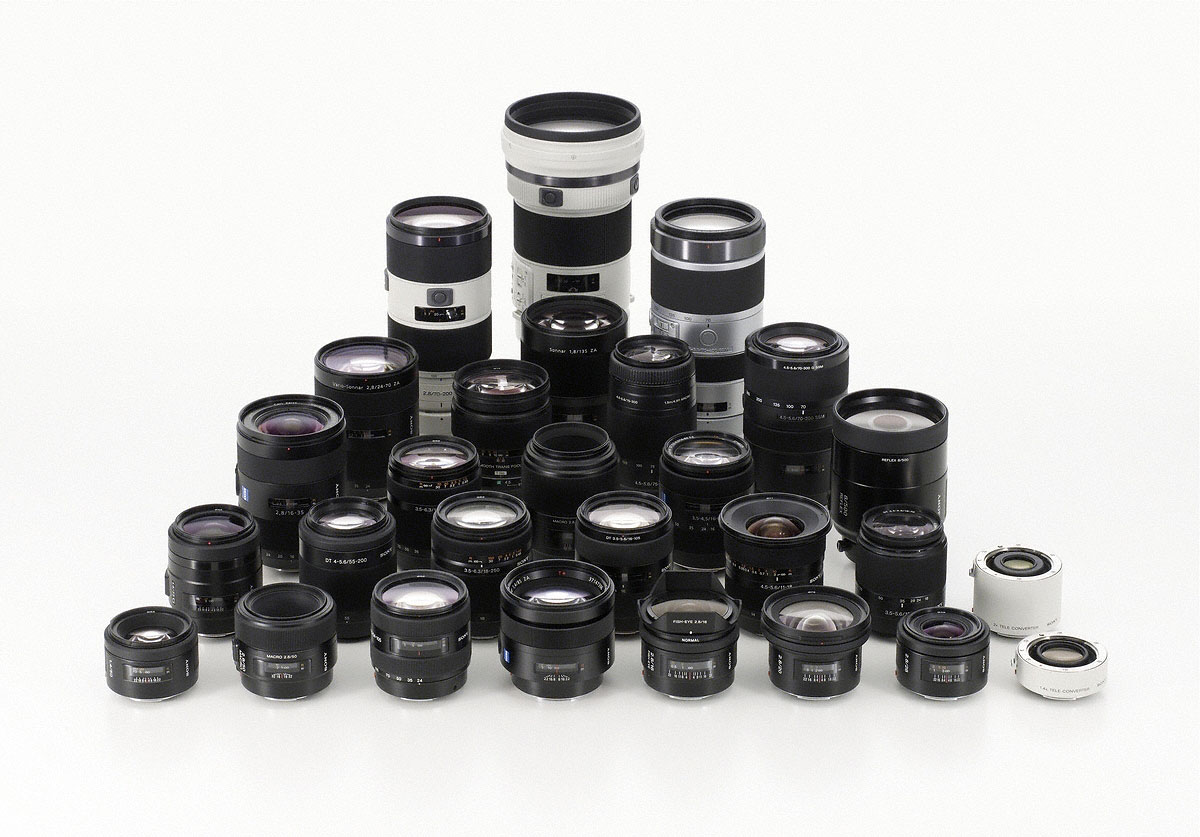
The Sony A230 is compatible with an array of new Sony lenses, and also with all Maxxum and Alpha lenses.
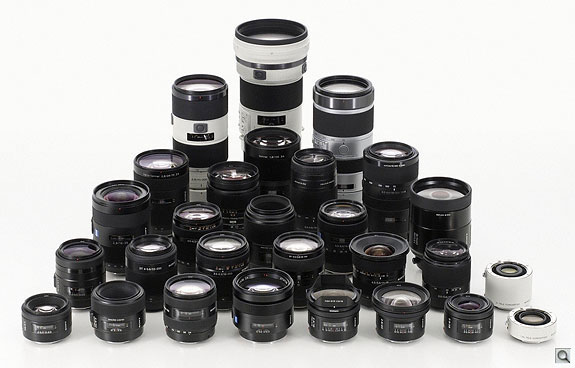
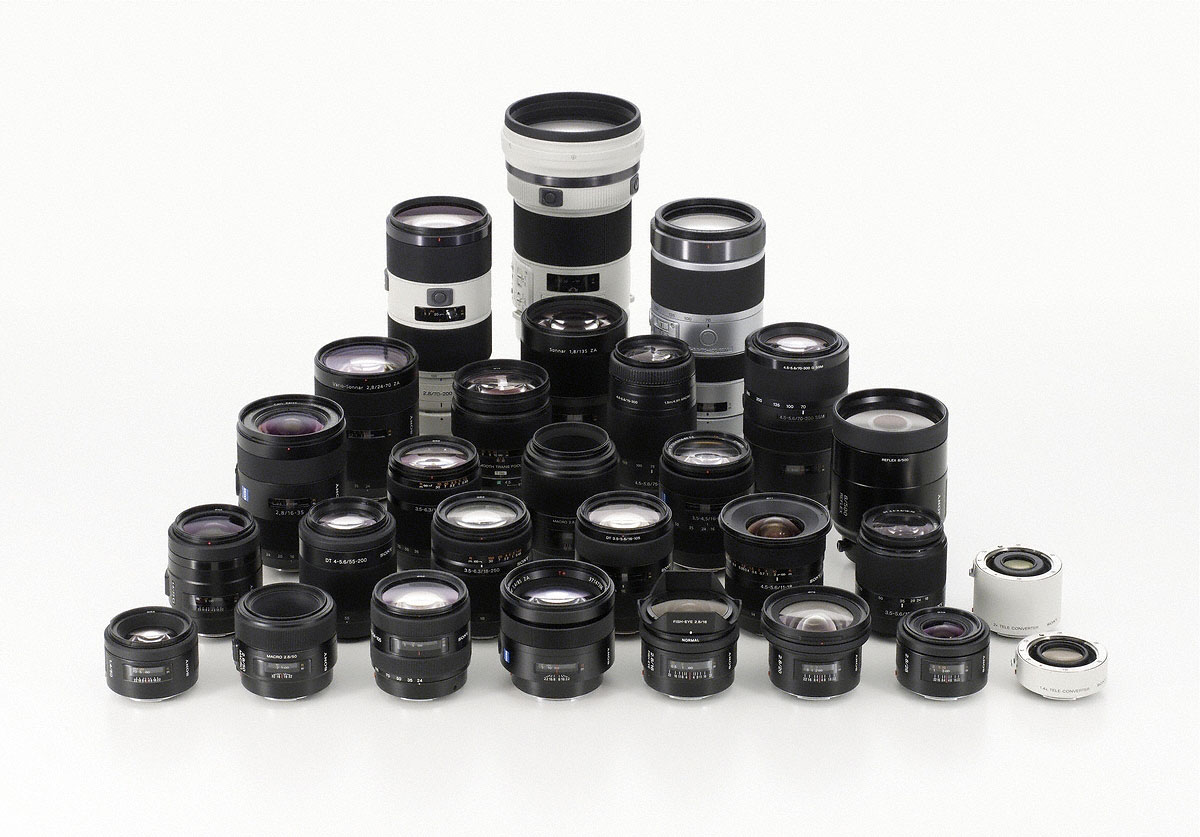
Twenty-six, plus two, plus four. Sony Alpha cameras are backed up by 26 current lenses, plus two teleconverters. This photo doesn't include the four new lenses announced with these cameras, which appear below.
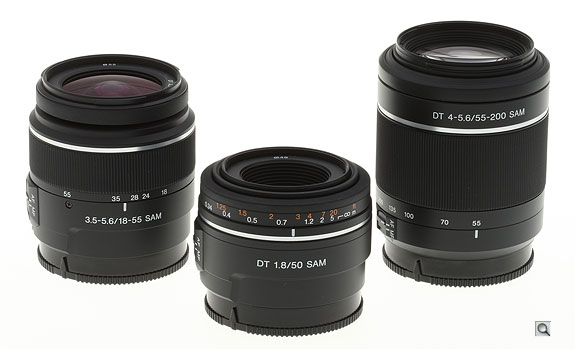
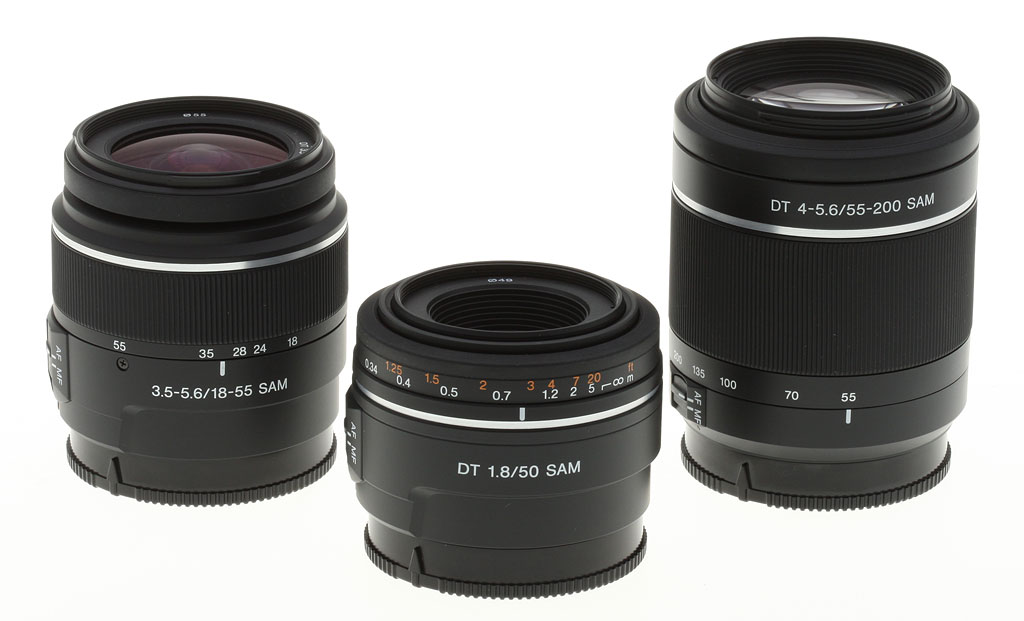
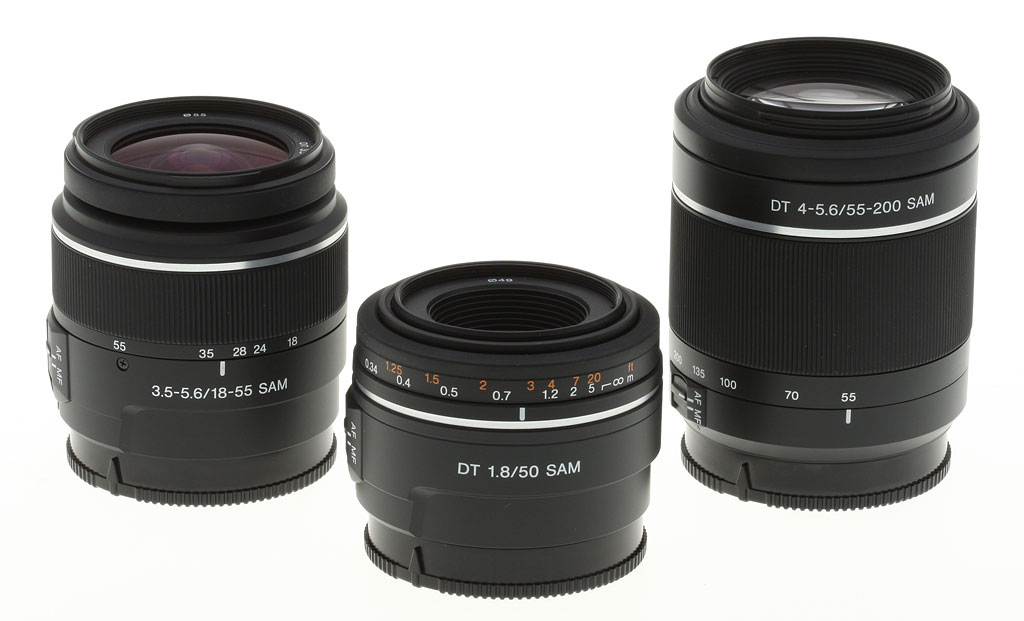
The three, plus yet another. Sony has announced four new lenses, labeled SAM for their Smooth Autofocus Motor. They're marked with a silver band around the barrel. Only three of the lenses are new: the 18-55mm f/3.5-5.6 ($200) and the 50mm f/1.8 (expected to retail for $150); the 55-200mm f/4-5.6 ($230) is a re-release of an older lens. Not pictured is the 30mm Macro lens.
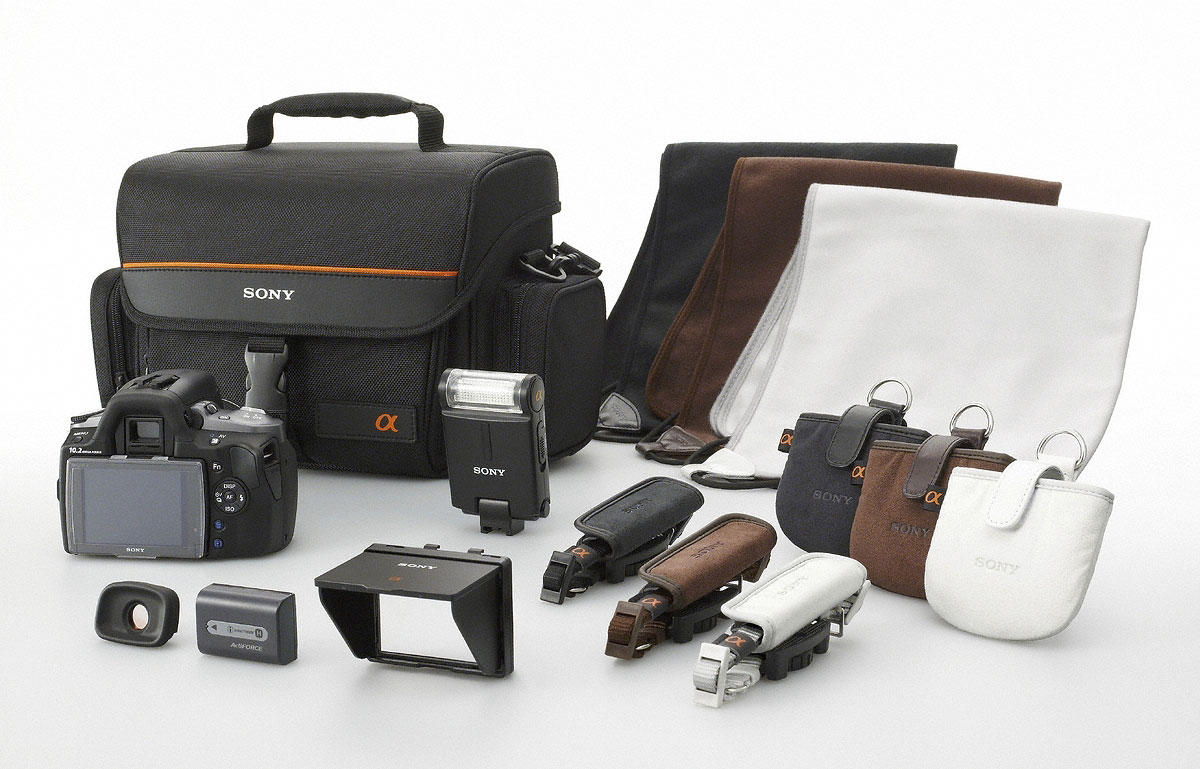
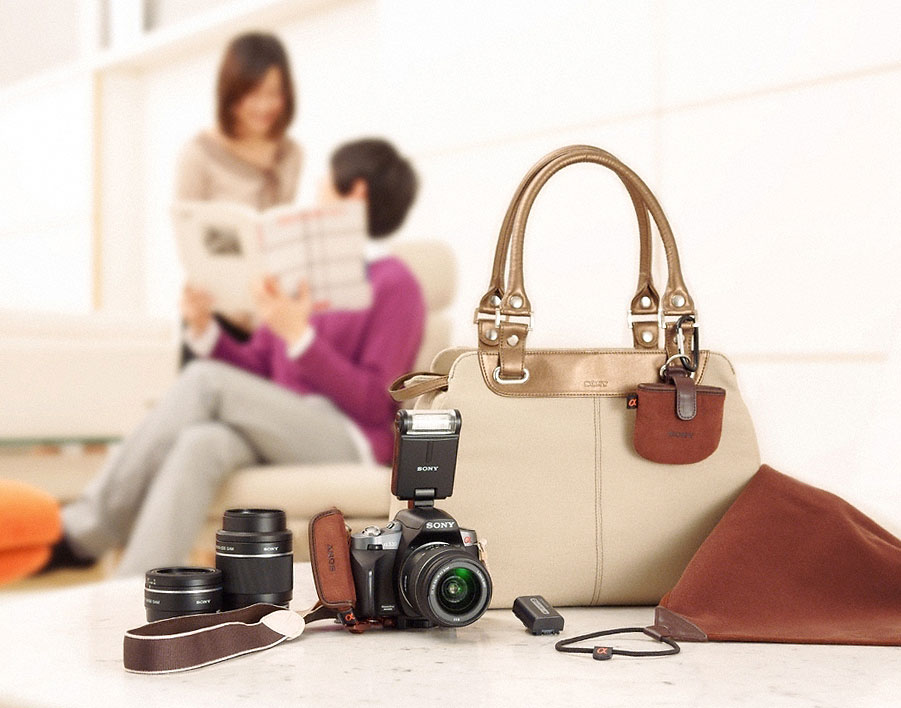
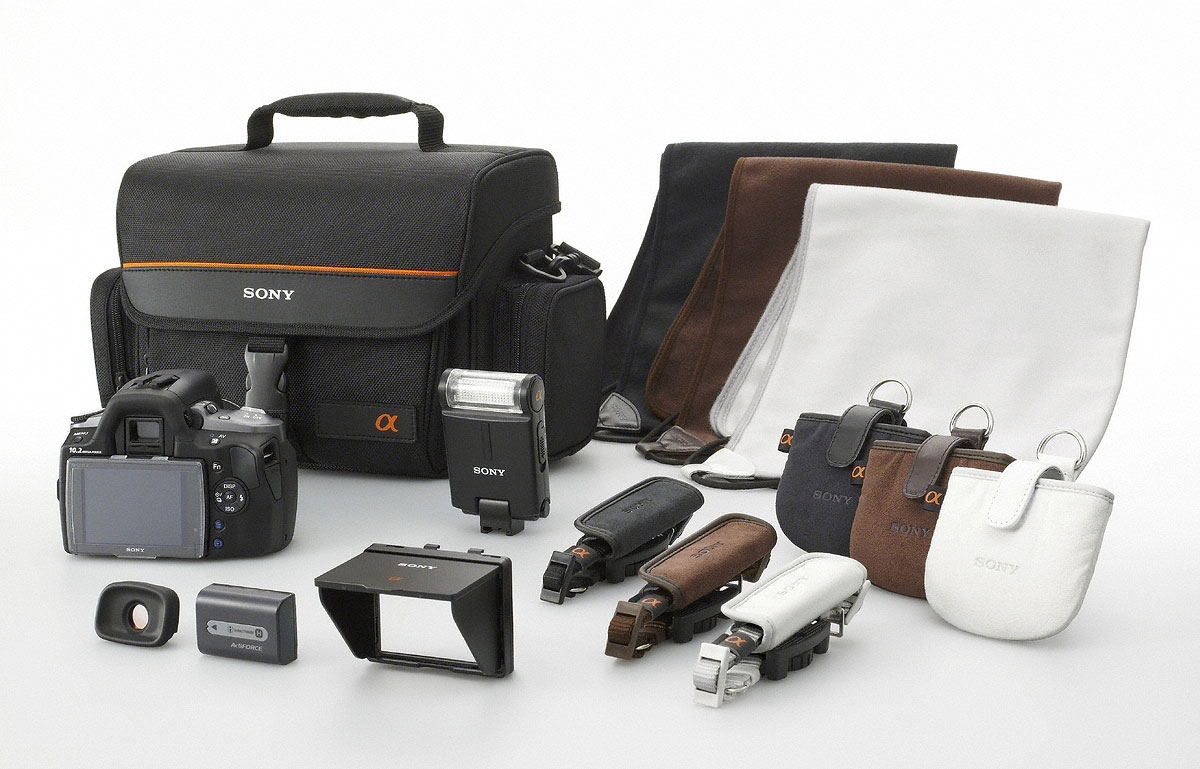
Accessories. Sony has also continued to expand their accessory offerings for the Alpha line, with new cases, wraps, lens bags, grip straps, a flash, an LCD cover, and an LCD shade.
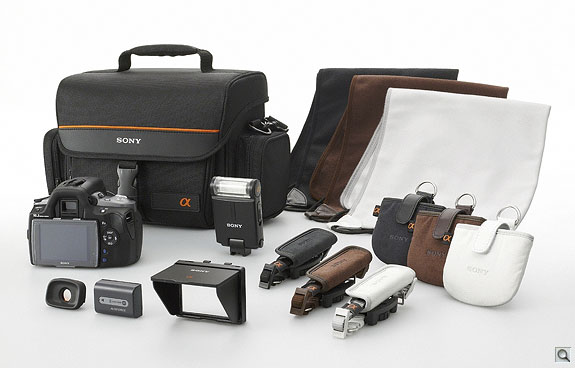
New Alpha accessories.
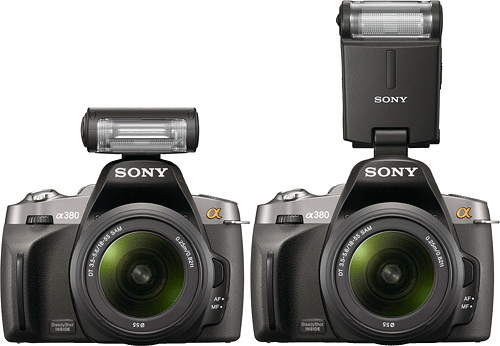
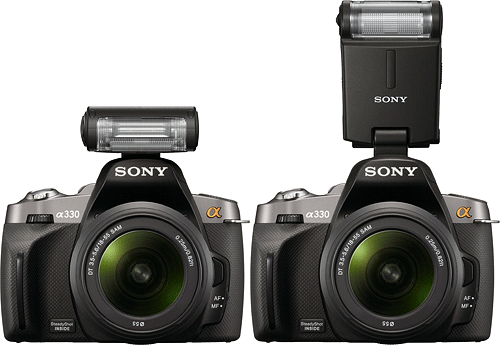
Our favorite accessory is the new small flash, which lays flat across the camera top for easy storage, and powers on when flipped up. The flash head inside the unit turns to face upward for bounce shots, and a diffuser pivots into place for wider shots. Called the HVL-F20AM, the new flash is expected to retail for $129, and uses two AAA batteries to keep the weight down. The Sony Alpha cameras have full control of the flash for through-the-lens exposure.
Another good idea is the thick cloth wrap with a shock cord that protects the Sony A330 while it's in a bag. Just lay the camera in the cloth with the lens facing the corner with the shock cord, and start folding the rear and side corners in. Finish with the shock cord, and wrap it around the back, under the body and stretch it around the lens. Viola! A protected camera. I think I'll buy several of these to protect review cameras, as well as my own personal cameras.
The lens cap pocket seems a little fastidious to me, but it's not a bad idea if you like a place for everything and everything in its place. The handstrap is probably the most important new accessory, given the Sony A330's minimized front grip. It's quite similar to a camcorder handstrap, with a soft, spongy fabric against the back of your hand; the only bit I don't like is the large mounting block that screws into the tripod socket on the bottom, which makes the Sony A330 a little less stable when placing the camera on a flat surface.
Missing from the accessory list for the new cameras is any mention of a battery grip, and I didn't see any additional contacts up inside the battery door on the early versions we saw. That's unfortunate, because battery life from the internal battery has dropped compared to the Sony A300, due to a new, smaller NP-FH50 battery pack. CIPA rating for the A330 is 510 shots with the optical viewfinder, and 230 when using Live View. That's down significantly from the A300's 730 shots with the OVF and 410 in Live View.
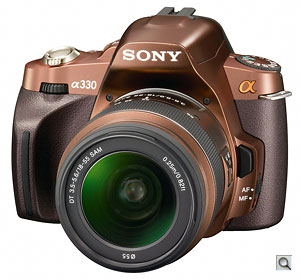
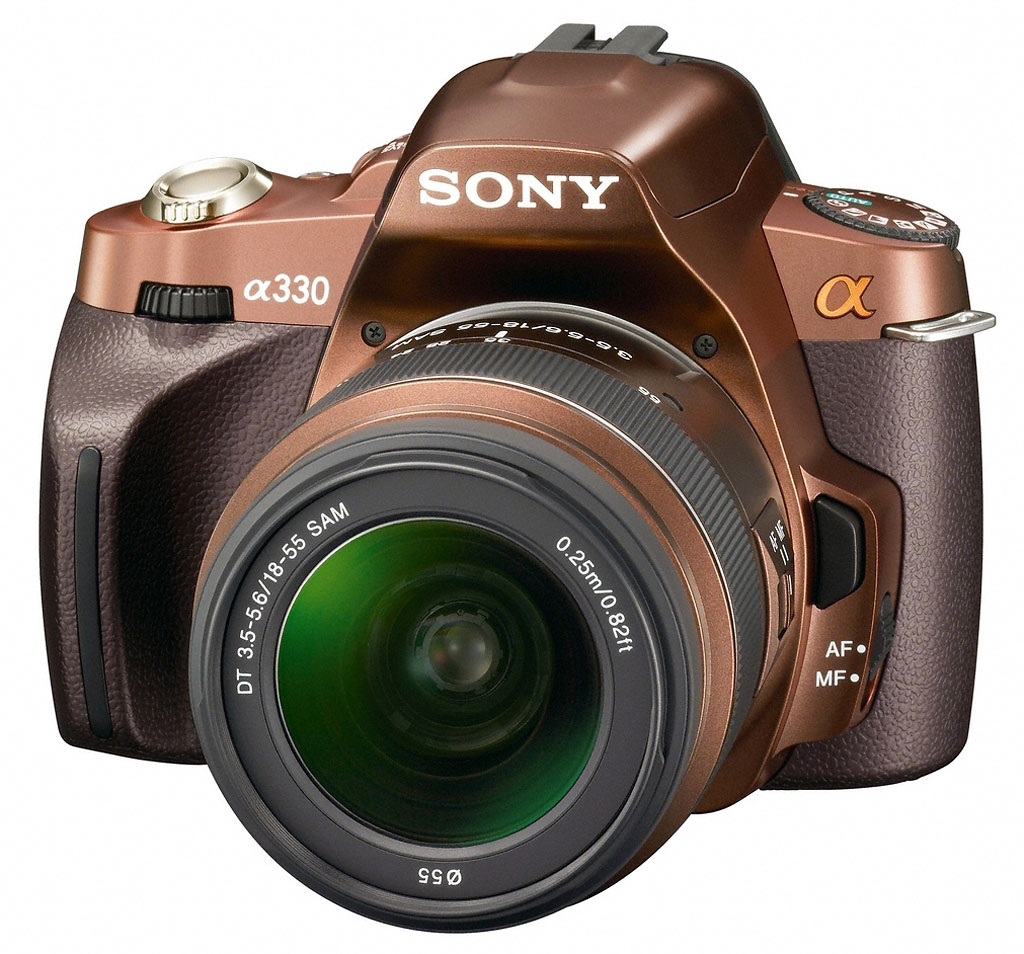
Speaking of accessories, there's also a special edition of the Sony A330 that is itself meant to be an accessory: the Copper Brown A330 pictured at right. It's an A330 in every other way, but its grip surfaces are brown, and the metallic surfaces -- including those of the kit lens body -- are a copper/brown color. They spoke with many focus groups, and this color combination was chosen overwhelmingly among the colors offered. One of the reasons given was that black lenses looked pretty good with the copper brown body, so people were most pleased with the color.
The copper brown version, model number DSLR-A330L/T, carries the same $849 price tag, is sold in the one-lens kit only, and will be available in Fall 2009. Brown is a very Fall color, after all, so it'll go with the accessories in common use by then. Always thinking, those Sony folks.
Analysis. Describing the Sony Alpha A330 and its siblings comes down to a relatively short list of what's new: a smaller, simpler body design, a new kit lens, a few tweaks to the menus and display screens, a new Self-timer mode, and a few other feature tweaks, plus some new accessories pretty well sums it up. The most surprising omission from Sony, one of the world's largest image-sensor manufacturers, is any new technology in the sensors, let alone a resolution increase. We don't believe that's a requirement, as 10 and 14 megapixels is just fine in this market, it's just surprising.
If Sony really is intent on changing the kind of consumer they attract and serve, drawing more people into the art of SLR photography, concentrating on affordable lenses and accessories makes a lot of sense. Sony may also try to stick to a schedule of annual upgrades in an effort to stay ahead of the competition, whose products are on an 18-month product cycle.
Shortcomings of the Sony A330 include the small grip, lack of a depth-of-field preview method, no movie mode, shorter battery life than its predecessor, and a very slow continuous capture rate of 2.5 frames per second, which makes it a poor choice for action photography.
In technological terms, the Sony A330 doesn't make any monumental leaps, but their Live View technology is in many ways miles ahead of the competition. The onscreen image may be a little softer, but Sony's Live View autofocus is much faster than any other digicam or SLR with live view, bringing digital SLR shutter-lag times to the world of live view. Sony's Live View method does not make adding video capture easy, however, so though they've announced three new consumer SLRs at once, none of them can compete with the Canon T1i or Nikon D5000 in the video capture column.
We're told that the image processing system in the Sony A330 and its brethren will improve on image quality, but as of this writing, we're not sure what form those improvements will take. That, and the quality of the new optics, including both kit lenses and the two primes, will help us complete our assessment of the new Sony A330. Until then, we can only say that the Sony A330 seems to be a high quality digital SLR whose hallmark, now more than ever, is providing one of the simplest routes to quality SLR photographs.
Sony A330 Basic Features
- 10.2 MP Super HAD CCD delivering resolutions as high as 3,872 x 2,592 pixels
- 3x Kit lens, 18-55mm (27-82.5mm equivalent), f/3.5-5.6
- Optical viewfinder
- 2.7-inch Clear Photo LCD Screen mounted on a tilting base
- ISO Sensitivity: 100 to 3,200
- Shutter speeds: 30 seconds to 1/4,000 second
- 2.5 frames per second continuous capture
- Secure Digital or Memory Stick Pro Duo memory card slots
- NP-FH50 Lithium-ion battery
- Dimensions: 5.03 x 3.8 x 2.8 inches (128 x 97 x 71.4 millimeters)
- Weight: 17.3 ounces (491g) with lens, without battery or card
Sony A330 Special Features
- Tilting LCD, with auto brightness control
- Live View mode
- Super SteadyShot in-camera image stabilization offers from 2.5 to 3.5 stops of compensation
- Bionz Image Processor
- Dynamic Range Optimizer: Normal DRO improves detail using standard gamma curves for fast shot-to-shot response time. Advanced DRO adjusts dynamic range area-by-area. Improved algorithm from Sony A900
- Anti-Dust Technology
- Auto Pop-Up Flash with four main operating modes and a variable Slow-Sync function
- External, proprietary flash hot-shoe for Sony accessory flash units
- Built-in support for wireless TTL flash exposure with certain Sony flashes
- Eye-Start Autofocus System
- 9-Point Center Cross AF Sensor
- Auto and Manual focus options with Single and Continuous AF modes
- 40-segment honeycomb metering system, plus Center-Weighted and Spot metering options, with AE Lock function
- Scene Selection Modes: Portrait, Landscape, Macro, Sports, Sunset, Night Portrait, and Flash-off
- Creative Style Settings
- sRGB and Adobe RGB color space options
- RAW and JPEG file formats
- Contrast, saturation, and sharpness adjustments
- Adjustable White Balance setting with presets and a manual option
- Index and Slide Show Display
- High-Resolution Thumbnails for PhotoTV HD Viewing
- Help features explain Function menu items and capture modes
- USB 2.0 High-Speed cable and interface software for connecting to a computer and downloading images
- HDMI output with option for NTSC or PAL selectable video output signal, with cable included
- Optional wired remote control accessories
- DPOF (Digital Print Order Format), Exif 2.2, Print Image Matching III and PictBridge compliant
Recommended Accessories
Model Differences
The table below summarizes the differences between the three new models.
Summary of Differences |
Feature | Sony A230 | Sony A330 | Sony A380 |
Total Megapixels | 10.8 | 10.8 | 14.9 |
Effective Megapixels | 10.2 | 10.2 | 14.2 |
Maximum Resolution | 3872 x 2592 | 3872 x 2592 | 4592 x 3056 |
Reduced Resolutions | 3:2
2896 x 1936,
1920 x 1280
16:9
3872 x 2176,
2896 x 1632,
1920 x 1088 | 3:2
2896 x 1936,
1920 x 1280
16:9
3872 x 2176,
2896 x 1632,
1920 x 1088 | 3:2
3408 x 2272,
2288 x 1520
16:9
4592 x 2576,
3408 x 1920,
2288 x 1280 |
Viewfinder Magnification | 0.83x | 0.74x | 0.74x |
Viewfinder Eyepoint (mm) | 16.5 | 19.7 | 19.7 |
Metering Sensitivity
(f/1.4 lens, ISO 100) | EV 1 ~ 20
(Spot:
EV 3 ~ 20) | EV 2 ~ 20
(Spot:
EV 4 ~ 20) | EV 2 ~ 20
(Spot:
EV 4 ~ 20) |
Live View Mode | No | Yes | Yes |
Tilting LCD | No | Yes | Yes |
LCD Brightness Adjustment | 5 steps manual | 2 steps auto +
5 steps manual | 2 steps auto +
5 steps manual |
Battery Life (CIPA shots) | 510 (OVF) | 510 (OVF)
230 (Live View) | 500 (OVF)
230 (Live View) |
Dimensions (WxHxD, mm) | 128 x 97 x 67.5 | 128 x 97 x 71.4 | 128 x 97 x 71.4 |
Weight (body only) | 452 g | 491 g | 489 g |
MSRP with 18-55mm lens | $549 | $649 | $849 |